
Die Bewerbungsfrist für das Sommersemester 2026 läuft vom 02. März bis zum 31. März 2026.
Die Bewerbung für eine Abschlussarbeit am Lehrstuhl für Supply Chain Management erfolgt in zwei Schritten:
- Wählen Sie zunächst online mittels der nachfolgenden Links drei Themen (Prio 1 bis 3) aus (Bachelorarbeit / Masterarbeit)
- Zusätzlich zur Themenauswahl senden Sie bitte Ihren tabellarischen Lebenslauf und Notenauszug an Elisa Glaser.
Bitte beachten Sie, dass nur vollständige Bewerbungen berücksichtigt werden können.
Die verbindliche Zusage für die Vergabe einer Abschlussarbeit erfolgt bis spätestens 08. April 2026.
Bachelorstudierende müssen zusätzlich das „Seminar zur Bachelorarbeit“ belegen. An allen Terminen des Seminars herrscht Anwesenheitspflicht.
Zusätzliche Hinweise für Ihre Bewerbung finden Sie hier.
Aktuelle Themen für Abschlussarbeiten:
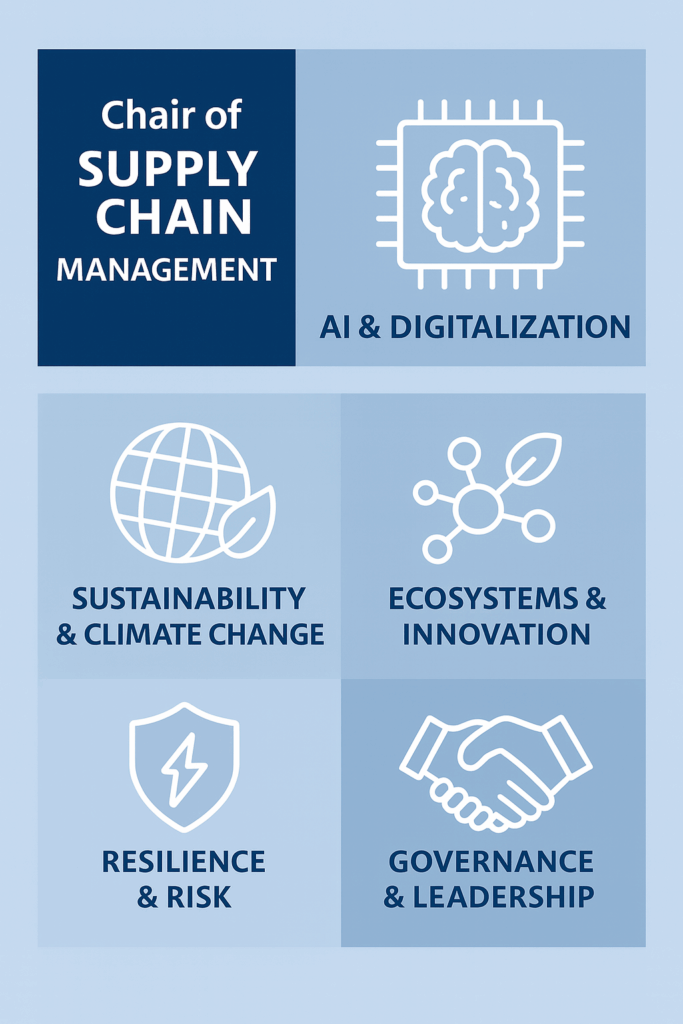
Die ausgeschriebenen Themen für Bachelor -und Masterarbeiten orientieren sich an den fünf Forschungsbereichen des Lehrstuhls. Darüber hinaus sind auch einige weitergehende Themen ausgeschrieben.
- Themenbereich #1: KI & Digitalisierung
- Themenbereich #2: Nachhaltigkeit und Klimawandel
- Themenbereich #3: Resilienz & Risiko
- Themenbereich #4: Governance & Leadership
- Themenbereich #5: Ecosystems & Innovation
Themenbereich #1: KI & Digitalisierung
Investigates the shift from periodic compliance audits to real-time AI-powered monitoring in procurement workflows. Organizations deploy anomaly detection, pattern recognition, and predictive flagging to catch fraud, corruption, and collusion as transactions occur rather than months later. The research examines governance trade-offs between automation and human oversight, focusing on purchase requisitions, invoice processing, and supplier onboarding. Expert interviews with procurement leaders, internal audit functions, forensic analysts, and technology vendors reveal adoption drivers, implementation hurdles, and emerging best practices for embedding continuous control mechanisms.
Surveys the state of research on applying artificial intelligence to uncover fraudulent behavior in procurement processes. Supervised and unsupervised learning approaches promise to detect invoice manipulation, duplicate payment schemes, bid rigging, and kickback patterns, but questions remain about data requirements, algorithm performance, and practical implementation. A systematic literature review across academic databases and practitioner sources maps existing detection methods, identifies research gaps, and proposes a taxonomy of AI applications for financial crime prevention in source-to-pay.
Investigates how digital platforms connect food retailers, restaurants, and manufacturers with charities, discounters, or consumers to redirect edible surplus away from waste streams. Platform architectures must coordinate matching algorithms with cold chain requirements and last-mile logistics, while stakeholder incentives range from tax benefits and CSR motivations to liability concerns and donation stigma. The literature review consolidates evidence on platform typologies, success factors, and obstacles to scaling such as fragmented regulation and operational complexity, ultimately developing a maturity model for IT-enabled food waste reduction networks.
Transportation and logistics sit at the center of decarbonization efforts, but “doing ESG” is hard because performance depends on diverse operations (fleet, hubs, warehouses, subcontractors) and inconsistent reporting boundaries (e.g., Scope 1/2/3 emissions). This topic explores how researchers and practitioners define and operationalize ESG in logistics—what indicators are used (environmental, social, governance), how they link to operational decisions, and where current metrics fail to capture real-world impacts. It also looks at the growing reliance on ESG ratings and composite indices, and the tension between “availability of data” versus “meaningfulness of measurement.” Finally, it considers how analytics can turn ESG data into actionable insights.
Logistics performance increasingly depends on asset uptime: vehicles, refrigeration units, forklifts/AGVs, conveyors, sorters, and automated storage systems. Failures can cascade into missed delivery windows, safety incidents, and inefficient “firefighting” maintenance. This topic explores how IoT condition-monitoring (telematics, vibration, temperature, utilization, error logs) enables earlier detection of degradation so maintenance becomes proactive and reliability improves. It also connects predictive maintenance to sustainability and resilience: fewer breakdown-related detours and idle time, better energy efficiency, longer asset life, and more stable service levels during peak demand.
AI increasingly supports high-stakes logistics decisions—routing, capacity allocation, inventory positioning, disruption response—where small errors can produce large operational and safety consequences. This topic explores what “trustworthy AI” means in real transport/logistics settings: robustness under distribution shifts (e.g., unusual demand spikes), security against manipulation or data issues, transparency/explainability for planners, and clear accountability when AI recommendations conflict with human judgment. It also addresses the human side: adoption depends on perceived reliability, appropriate human oversight, training, and governance practices that make AI decision support usable in time-pressured operations.
Themenbereich #2: Nachhaltigkeit und Klimawandel
Explores how firms are redesigning their supply chain data architectures to comply with the EU’s Carbon Border Adjustment Mechanism, which mandates granular emission attribution at the product level. Traditional origin-tracing systems must now capture embedded carbon across multi-tier networks, raising questions about industry standards, data governance challenges, and supplier cooperation in legacy IT environments. Semi-structured expert interviews with sustainability managers, supply chain architects, and compliance officers surface implementation patterns, integration strategies, and a framework for emission data readiness.
Examines why textile manufacturers in emerging markets struggle to scale upcycling initiatives despite growing pressure to valorize production waste. Cutting scraps, off-spec rolls, and defective goods accumulate in facilities, yet efforts to recapture value often fail due to sorting infrastructure gaps, contamination risks, volume thresholds, and misaligned buyer incentives. Multiple case studies across facilities in Bangladesh, Vietnam, and Turkey combine site visits with interviews of plant managers, waste brokers, and brand sourcing teams. The research identifies replicable enablers and develops a barrier typology for circular interventions at supplier level.
Analyzes how fashion brands and retailers implement circular business models through garment collection, resale, recycling, and design-for-disassembly initiatives. Consumer take-back programs vary widely in effectiveness, while digital passports and fiber tracing technologies offer new possibilities for material recovery. The review synthesizes findings on adoption rates, value recovery mechanisms, consumer behavior, and the growing influence of Extended Producer Responsibility regulations. Results culminate in a framework for assessing circular readiness in apparel supply chains.
This thesis analyzes the actual operating costs of Battery Electric Vehicles (BEVs) compared to internal combustion engine vehicles based on real market data. The focus lies on evaluating public charging tariffs, charging losses, and maintenance costs.
The shipping industry must significantly reduce its emissions. This study focuses on sustainable propulsion technologies (such as methanol, ammonia, and hydrogen) and their economic and regulatory frameworks. Which technologies are realistic in the short and long term? How do IMO regulations influence investment decisions? How important are “Green Shipping Corridors”?
Using scenario analysis, potential future visions for ocean transit are explored. Technological, geopolitical, and environmental trends are taken into account. How could autonomous ships transform the industry? What geopolitical risks affect maritime trade routes? How do climate-related hazards impact maritime infrastructure?
Electric mobility is developing rapidly worldwide. At the same time, there are differences in policy objectives, market trends, and industrial production capacity. The aim of this study is to analyze and compare policy targets for electric mobility with actual trends in vehicle registrations as well as production capacity for batteries and electric vehicles.
Global competition in the electric vehicle market is increasingly shaped by technological innovations and market share. The aim of this thesis is to analyze the market shares of German automakers in an international comparison and to assess their technological positioning in the field of electric mobility.
The expansion of the charging infrastructure is considered a key prerequisite for the widespread adoption of electric mobility. To this end, the federal government has adopted relevant master plans. The aim of this study is to evaluate the existing master plans for expanding the charging infrastructure and to analyze current pricing and tariff models for public charging.
Themenbereich #3: Resilienz & Risiko
This thesis reviews the literature on decision-making in distribution and outbound logistics under uncertainty, including demand variability, delivery disruptions, and capacity constraints. It analyzes which types of uncertainty are addressed in distribution decisions, what decision approaches (e.g., optimization models, heuristics, rules, or human judgment) are described, and how trade-offs between service level, cost, and responsiveness are handled. The study further investigates which distribution decisions are most affected by uncertainty (such as routing, allocation, or shipment prioritization) and identifies research gaps in understanding real-world decision-making in distribution processes.
This thesis systematically reviews the academic literature on supply chain disruptions and recovery processes to synthesize current knowledge on how supply chains respond to and recover from disturbances. The study examines which types of disruptions are analyzed in the literature (e.g., supply shortages, transport interruptions, demand shocks, production failures), how disruption impacts propagate through supply chains, and which recovery strategies and operational response measures are described. It further investigates how recovery processes are conceptualized and measured, including recovery timelines, performance restoration, and resilience outcomes. The review also identifies theoretical perspectives and methodological approaches used in disruption and recovery research and highlights gaps in understanding real-world recovery processes in supply chain and operations contexts.
Themenbereich #4: Governance & Leadership
This thesis systematically reviews academic and practitioner literature to identify the leadership competencies required of contemporary supply chain managers. The study examines which competencies are considered critical across different SCM functions such as planning, logistics, sourcing, and operations, how competency requirements have evolved in response to digitalization and increasing disruption, and which future-oriented capabilities (e.g., resilience, systems thinking, foresight) are emphasized. The review aims to synthesize existing competency models and develop an integrated framework of SCM leadership competencies.
This thesis explores how operations and supply chain leaders anticipate future uncertainty and align production and logistics processes accordingly. Based on expert interviews, the study examines how leaders perceive and anticipate future disruptions and uncertainties, which foresight practices and tools they use in operations and logistics planning, and how anticipated future conditions are translated into aligned production and logistics processes. It also investigates organizational mechanisms that support foresight-driven alignment and the challenges leaders face when integrating foresight into operational decision-making.
This thesis examines leadership practices that enable effective collaboration between organizations in supply chains. Drawing on expert interviews, it investigates which leadership behaviors foster trust and information sharing across organizational boundaries, what coordination and governance mechanisms support interorganizational collaboration, and which challenges leaders encounter in cross-company supply chain relationships. The study also explores how leadership influences collaboration performance and relationship quality in supply chain partnerships.
Themenbereich #5: Ecosystems & Innovation
This thesis investigates how handover processes between production and logistics are designed and managed in manufacturing plants. Through a multiple case study, it analyzes how material and information flows are coordinated at the production–logistics interface, which roles and responsibilities structure the handover process, and what typical challenges or inefficiencies occur at this operational boundary. The study further examines which design principles characterize effective production–logistics handover processes and how plants structure and standardize these interfaces.
Warehouses and last-mile networks are increasingly complex systems with tight service windows, volatile demand, congestion, and frequent disruptions (e.g., labor shortages, capacity shocks, weather). Digital twins—virtual replicas of physical operations fed by operational data—are used to test “what-if” scenarios and optimize decisions (layout, picking/packing, routing, rebalancing) before changes are implemented in the real system. In sustainability terms, the topic explores how twins support lower energy use and emissions (e.g., fewer empty miles, smoother flows, reduced congestion). In resilience terms, it examines how twins help anticipate and respond to disruptions via simulation, real-time monitoring, and predictive analytics.
A comparative analysis of the building law, energy economy, and institutional frameworks. The thesis investigates which exact legal levers in German condominium and tenancy law (WEG/BGB) as well as building regulations need to be adjusted to adapt the Dutch model.
This thesis evaluates the current state of public charging stations and mobility provider applications regarding GDPR (DSGVO) compliance and IT security standards. It systematically analyzes data minimization, user tracking, and the security of digital payment interfaces as potential technological and trust-related barriers to user acceptance.
In Germany, the promotion of electric mobility is carried out through various programs and ministries. The aim of this study is to analyze existing funding programs, institutional responsibilities, and the distribution of funding in the field of electric mobility.
The Netherlands is considered one of the leading countries in the expansion of public charging infrastructure. The aim of this study is to benchmark the Dutch infrastructure strategy and identify success factors for other European countries.
China is pursuing a comprehensive, holistic industrial policy strategy to promote electric mobility. The aim of this thesis is to analyze China’s industrial policy measures for the development of the electric vehicle and battery sectors and to assess their impact on global competition.
Denmark and Norway are considered pioneers in the adoption of electric vehicles and bidirectional charging. The aim of this study is to analyze the policy instruments and market conditions in Denmark and Norway.
The development and ramp-up of electric mobility vary significantly across Europe, particularly in terms of growth rates and the density of charging infrastructure. The aim of this study is to compare German growth rates for electric vehicles and the density of charging infrastructure with the EU average.